Alumni Profile – Heather Clark

Alumni campaign article for the Faculty of Education | September 2022

Educator| Wilson School of Design, Kwantlen Polytechnic University
MEd in Home Economics Education, 2020

Walking into the Wilson School of Design at Kwantlen Polytechnic University (KPU), one is immediately struck by all the natural light in this very modern building – fitting for a campus housing a Fashion, Design and Technology program.

Heather Clark is an Instructor and Program Chair of the Fashion and Technology Program with the Wilson School of Design at KPU. She is also an Adjunct Professor at UBC with the Bachelor of Education program working with Home Economics teacher candidates. She is an alumna of the UBC Faculty of Education, having completed her Master of Education in Home Economics Education in 2020.

Her insight as an alumna of the UBC BEd and MEd programs, combined with her current role at KPU, uniquely position her for her Adjunct Professor responsibilities.

“It’s been a really nice full circle piece of combining both roles, looking at how [to] educate future educators who then could potentially be educating and teaching and working with applicants for the Fashion & Technology Program,” Heather reflects.

She thinks back fondly on the faculty members that shaped her learning during her MEd in Home Economics, including Dr. Kerry Renwick. “The right type of people can push you to do better, and do more and question different things and bring different perspectives, which is so amazing,” Heather notes. She adds that the passion of Home Economics educators is incredibly infectious.

“[The program] gave me pause to figure out what makes me really excited and passionate about what I’m doing, and how [I can] do more of that.”

The learning Heather gained from her MEd program has expanded the way she approaches her teaching, and has enabled her to apply an inquiry-focused lens in her lessons, and to pull from other educational approaches like transformative, hands-on, and experiential education. She embeds these philosophies in subtle yet impactful ways throughout her courses at KPU and also with her UBC teacher candidates. “It is so exciting to see the lightbulb go off when everything comes together,” Heather remarks.

Completing the MEd program has given Heather more confidence in her academic writing, so much so that she has now initiated a successful program review process at KPU. It also has given her the broad perspective needed to reflect on her career trajectory and the possibilities of how that will evolve in the future.
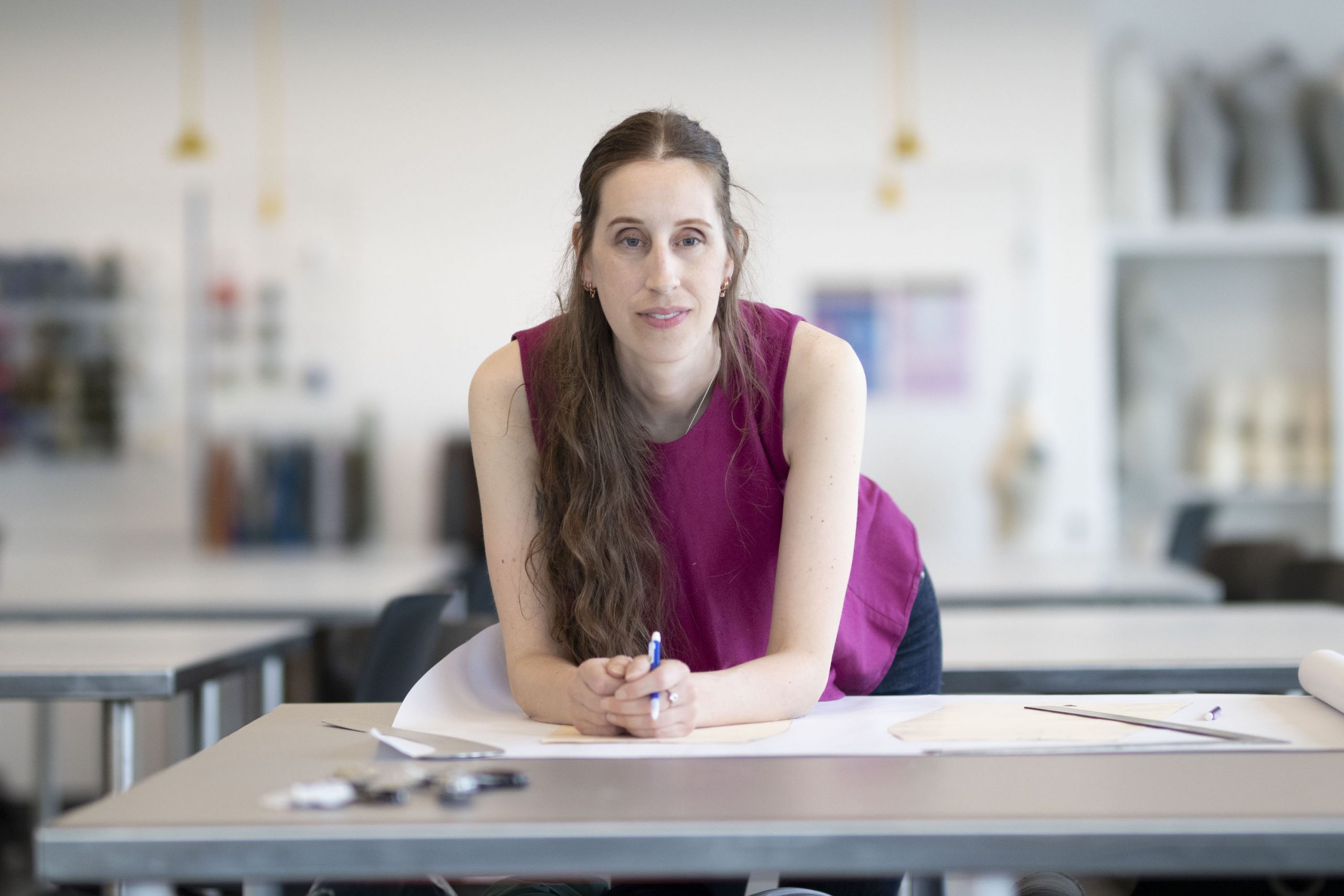
“It’s given me some thought on how I want my career to shift in the future. It gave me pause to figure out what makes me really excited and passionate about what I’m doing, and how [I can] do more of that.”

Heather leads us on a tour of the Wilson School of Design building which reveals large open classrooms and numerous displays of student work on hallway walls. One particular exhibit features a selection of silky gowns showcased in a large glass display that seem to belong on a runway or red carpet rather than a campus hallway, really speaking to the immense level of talent these students possess.

We arrive at the Sewing Lab where she teaches – a well-lit room made up of tall tables and chairs on one side, and about two dozen sewing stations on the other. A back wall of floor-to-ceiling windows is lined with industrial ironing boards and steam irons hooked up to gravity feed bottles that look eerily like IV drips, reflecting the volume of ironing regularly taking place in the class. A wall near the front of the class houses colourful spools of thread organized in a perfect rainbow gradient, with a huge range of hues and shades to choose from. The adjacent wall boasts mannequin heads and torsos arranged side-by-side like a limbless conga line, awaiting their next fitting.

Heather’s excitement while giving a tour of her classroom is palpable – she takes great pleasure in showing us the various parts of the room, and the different equipment, materials and tools her students use on a daily basis. As she unravels colourful fabrics of different materials and consistency, she lets out a yelp of appreciation over a shimmery blue piece that catches her eye. She shows us a huge pair of fabric scissors and a curved machete-like ruler, displaying the tools of her craft like a proud market hawker showing off her wares.

“It all comes back to a similar foundation, and for me it’s that love of teaching and sharing skills and knowledge.”

Heather has spearheaded an initiative to create an open access platform for sewing students at all levels. Along with another colleague – Catherine Hay in the Delta School District – Heather received an Open Education Resource Grant through KPU and was able to launch her online resource, Stitched. She specifically wanted this resource to provide on-demand learning, and to not just be another digital textbook. The site is still a work-in-progress, with Heather and Catherine contributing to the content as often as they can, and they are hopeful that this will be a valuable sewing, textiles and fashion teaching resource for secondary and post-secondary learners. With the funding from this UBC alumni campaign, Heather was able to purchase some video recording supplies in order to continue producing video content tutorials for the Stitched website.
Heather informs us that the KPU sewing courses are becoming quite sought after, with long waitlists a regular occurrence each semester. I’m convinced that her impact as an educator is at least partially responsible for the popularity of the sewing program, and it’s also what keeps her motivated. “It all comes back to a similar foundation, and for me it’s that love of teaching and sharing skills and knowledge,” Heather confides.

In her own teaching, Heather greatly values experiential education, and encourages her teacher candidates to take their future students out on many field trips. Heather has taken her own students on field trips to places like Herschel and Lululemon, and wants them to visualize possible future careers and to understand that there are so many different pathways for them to go on including working as concept designers, project managers, product developers, technical designers, colourists – everything from ideation to creation for retail.

As we end our tour of the school, Heather informs me that her next meeting is with some international vloggers, and it becomes clear that there is a lot more to her days than simply teaching sewing classes. We see the vloggers enter on our way out, and Heather has already switched gears and is ready to go, introducing herself in a confident and cheerful voice, and leading them away into her sewing wonderland, looking every bit in her element.

Article written by Milena Constanda | September 2022
Photos by Milena Constanda

View full article.

Alumni Profile – Jackie Hamnett

Alumni campaign article for the Faculty of Education | September 2022

Teacher | Birchland Elementary
MEd in Curriculum Studies (HOPE), 2021

An appetizing smell greets us as we walk through the doors of Birchland Elementary school in Port Coquitlam on a muggy Wednesday morning.

“It’s toast and smoothies today” Jackie Hamnett informs me, explaining that a member of staff – the school youth and family worker – has successfully run a breakfast program for years. Today’s breakfast smells warm and comforting, despite its simplicity, but Jackie lets me know that other breakfast days can be much more intricate and creative.

Jackie Hamnett is an alumna of the UBC Faculty of Education, having completed the Master of Education in Curriculum Studies – Health, Outdoor, and Physical Experiential Education (HOPE) cohort in 2021.

“It reminded me that it’s good to be brave and to try different things even though I’ve been teaching a long time. Going into that environment where you’re constantly learning, it revitalizes you.”

This unique program was pioneered by the late Dr. Joy Butler, who passed away in September 2019, during Jackie’s program. After her passing, Drs. Hart Banack and LeAnne Petherick stepped in to ensure Joy’s ambition for the program was continued.

“Joy had a real vision, but both LeAnne and Hart were able to carry on that vision. There was a lot of enthusiasm, and a lot of patience and understanding and insight. They were very gentle and inspiring with the whole group,” Jackie remembers.

Jackie has been a teacher for 32 years – including teaching briefly in Italy and the UK – and she has been at Birchland Elementary for 6 years. Completing a Master’s degree at this stage in her career was admittedly challenging, but ultimately very rewarding for Jackie.

“It reminded me that it’s good to be brave and to try different things even though I’ve been teaching a long time. Going into that environment where you’re constantly learning, it revitalizes you. When it was all over, I felt like, wow, I really achieved something.”

The community of students during Jackie’s program were a real highlight – her colleagues in the program were at different stages of their careers and their learning, and they were always supportive and empathetic towards one another. “There was a lot of camaraderie amongst people. It wasn’t competitive, it was very much a collegial thing – let’s learn, let’s improve together, let’s do this together,“ Jackie reflects.

“I know that there’s a lot of research to prove that what we’re doing is beneficial. We’re not just going outside to ‘play’. There’s so much that I can do outside that covers the curriculum.”

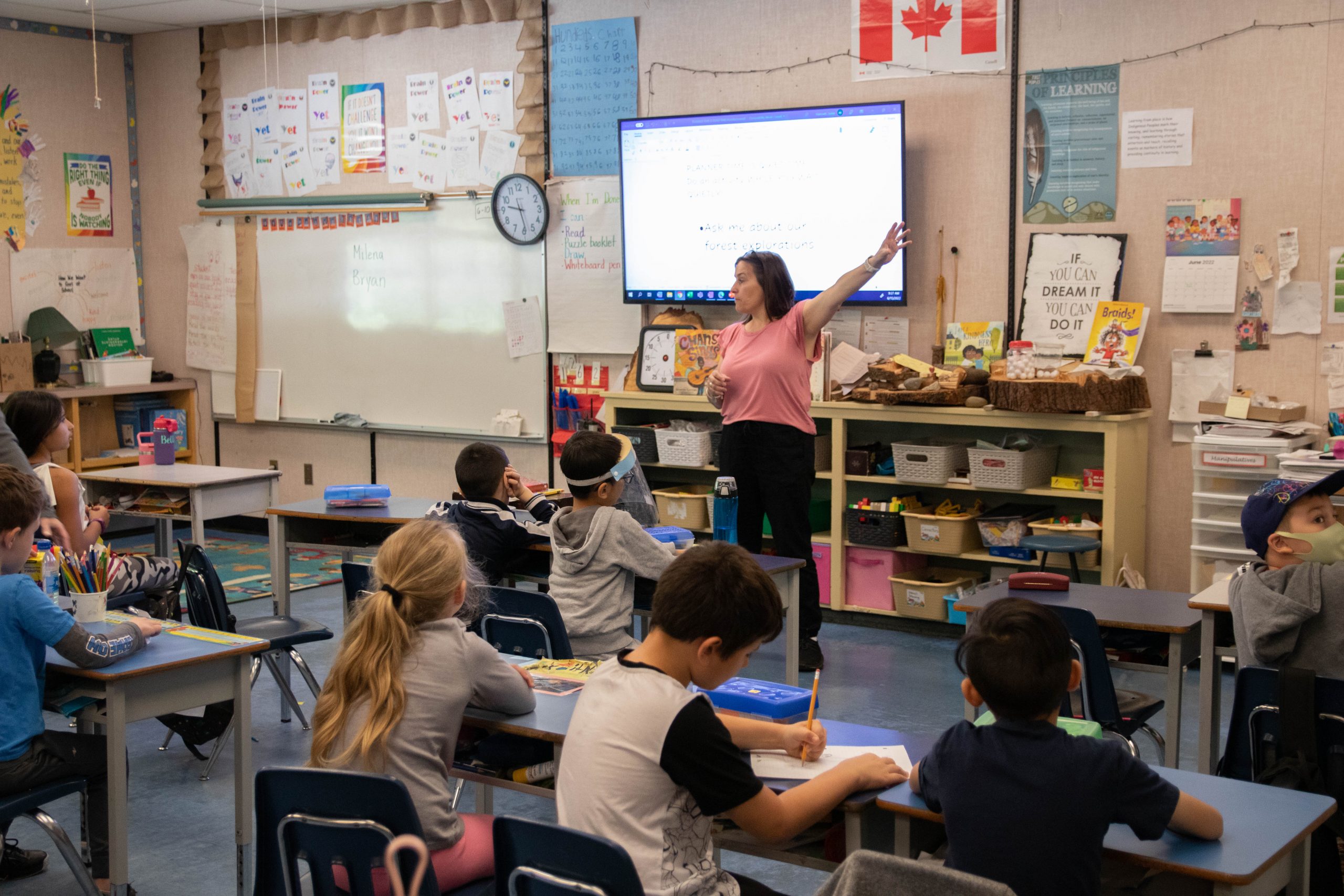
As we continue to make our way down the halls, we walk by walls decorated in children’s art and noticeboards, and stop as Jackie greets her colleagues on the way to her classroom. Upon entering the class, I am flooded by a visual smorgasbord of colour, patterns, pictures, and children’s art. Desks are gathered together in groups of two or three, and inspirational posters impart wisdom like “Mistakes are proof I am always growing” and “Do the right thing even if nobody is watching” throughout the cozy classroom. Books and supplies line shelves against the walls, and a large digital screen tops the front of the room – a beautiful organized chaos.

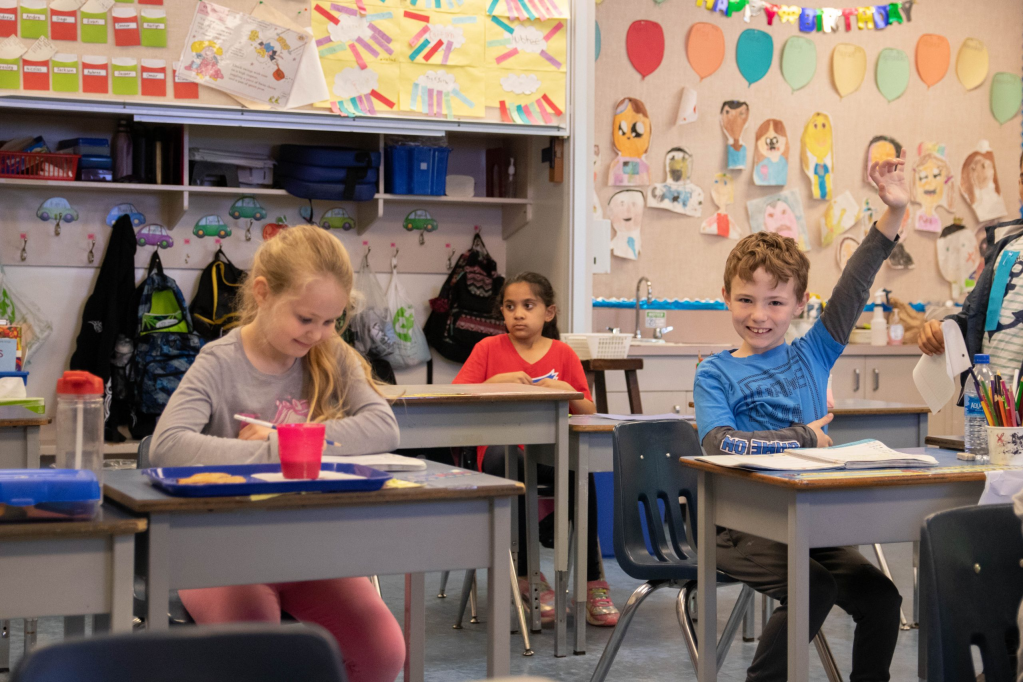
The bell rings, and the kids are lined up outside the door. Ms. Hamnett teaches Grades 2 and 3 this term, and several 7- and 8-year-olds start to enter the class. They put their backpacks and lunch bags away in their labeled cubbies at the back of the class, and start to settle into their desks.

“I’m going to be so warm today if the sun comes out, I’m wearing all black” one student yells to another across the room. Another is consoled by Ms. Hamnett because he’s missing a drink in his lunch bag, while a Teaching Assistant lets Ms. H know she’ll go and get him a water bottle from the staff room. A morning announcement acknowledges land and place, announces which teachers are on recess duty, and wishes the kids a good school day.

Ms. Hamnett makes her way to the head of the class and calls for attention – the noise quickly dies down. She takes attendance and the students respond with “Good Morning!” to indicate their presence, filling the room with an exciting and happy energy that promises a fun day ahead.

The students are assigned their regular morning activities, and they begin to fill out their notebooks, then move on to quiet play around the classroom. They are all at ease and content with this routine morning structure, and they fall into it effortlessly. A handful of boys play with various toys seated on a mat on the floor, a couple of girls sit down with a card game, while others sit solo and create art from construction paper or write in journals.

Jackie had warned me about bears in the area, and so when a ‘Shelter in Place’ announcement comes on over the PA system, I’m not too worried. In fact, it’s a common announcement at this time of year and the need for caution near the outdoor forest space surrounding the school is a real one. Jackie is always keeping this in mind, but with an MEd specializing in Outdoor Education, she won’t let that stop her. Once the second announcement giving the all clear comes on, she announces to the class that we’re headed outside!

“Going outside shows a different side of students. Some who may be quiet in class come outside and they love it, the freedom to run around, to build and to play. You can see their strength in different ways.”

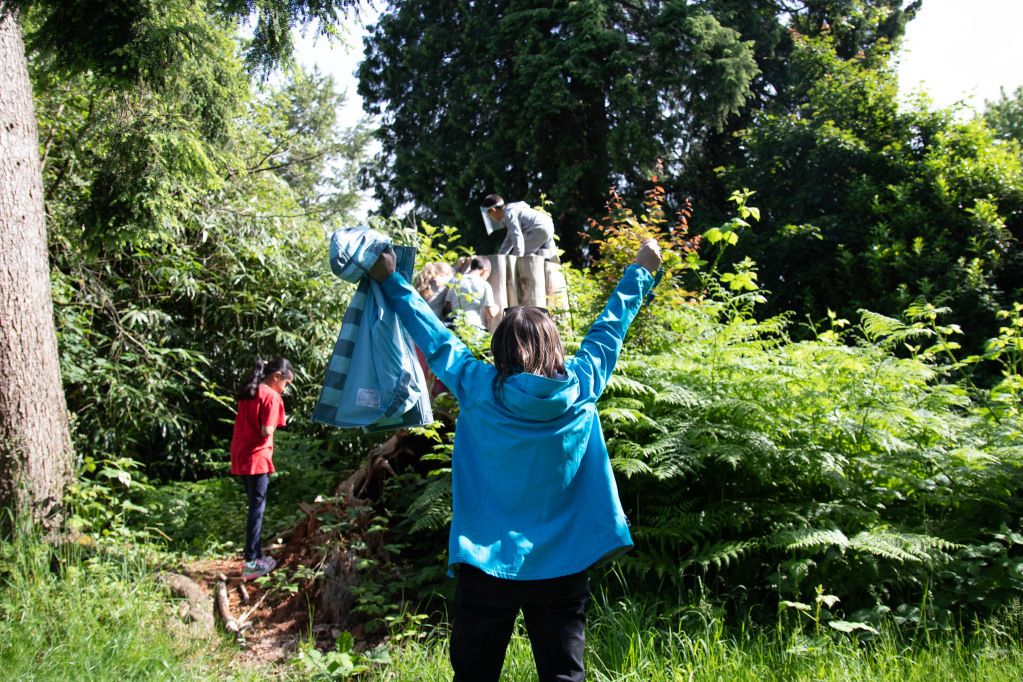
With a wooden cart filled with outdoor toys and supplies in tow, the kids march single file out towards the forest, like a happy row of ants. With direction from Ms. Hamnett, they lay out a tarp on a patch of grass and are given permission to go and explore, being mindful to keep to a limited area of the forest that she can keep an eye over. Glee erupts from the kids, and they are off in all directions.

A few climb a wooden stump perched on the top of a small knoll, others pull at reeds, bamboo, and the leaves around them. They create make believe swords and duel it out, or they spin sticks around like nun chucks. Still others pick salmon berries from the bushes and try to outdo each other for the best berry-picking spot.

Ms. Hamnett is everywhere: she is passing sticks to the stump crawlers one moment, play-fighting with stick swords the next. Repeated calls of “Ms. Hamnett” rain down around her and without skipping a beat, she answers all. She channels her energy into the kids like a mother goose with newborn goslings. She radiates patience, excitement, and a genuine affection for her students.

Jackie explains that the field of outdoor education is so versatile, and that there are so many different things that kids can learn from being outside. She hopes to impart lessons of respect for their local environment that will carry with them many years into the future, enabling them to take responsibility for the nature around them. What she also loves about the field is what it brings out in the kids.

“Going outside shows a different side of students. Some who may be quiet in class come outside and they love it, the freedom to run around, to build and to play. You can see their strength in different ways,” she says.

Her specific degree has also given Jackie the confidence and justification she needed to keep practicing the principles of outdoor learning she has always valued. “The benefit [of the MEd in HOPE] is that now when I take the students outside, I know that there’s a lot of research to prove that what we’re doing is beneficial. We’re not just going outside to ‘play’. There’s so much that I can do outside that covers the curriculum,” Jackie explains.

With the funding from this alumni campaign, Jackie was able to purchase various tools and gadgets the kids can use outside, including magnifying glasses, potato peelers, dry erase pens and boards, bungee cords, books, and even some reusable rain jacket pouches for those rainy Westcoast days.

“You have to have that relationship with the students before you can even think about them learning something, but once you have that bond with your students then there’s so much you can do.”

After free play, Jackie gathers the students and has them sit on the tarp. Next up she explains they will get their clipboards and draw anything they see in the forest, either with their naked eye or through a magnifying glass she has provided.

The kids settle in to draw in hushed contentment, and Jackie has a rare moment to breathe. Inevitably, however, within seconds the sounds of “Ms. Hamnett, look at my leaf” and “Ms. Hamnett, I drew a salmon berry” fill the air. She is not frazzled though – it’s all in a day’s work.

“You have to have that relationship with the students before you can even think about them learning something, but once you have that bond with your students then there’s so much you can do.”

Article written by Milena Constanda | September 2022
Photos by Milena Constanda

View full article.

Alumni Profile – Mackenzie Radomski

Alumni campaign article for the Faculty of Education | September 2022


Kindergarten Teacher | Westcot Elementary
MEd in Early Childhood Education, 2019

 
Westcot Elementary sits tucked away just off the Trans-Canada Highway in West Vancouver. The grounds boast two large fields, an extensive playground, and more recently a new Gathering Tree – an initiative spearheaded by Mackenzie Radomski and some of her colleagues.

Mackenzie graduated from the UBC Faculty of Education with a Master of Education in Early Childhood Education in 2019. She has been a Kindergarten teacher at Westcot Elementary for 3 years; the Gathering Tree initiative is a project she hopes will bring the school community together through their natural surroundings, with a goal to collaborate, inquire and explore together, and to incorporate Indigenous ways of knowing into the learning.

“The goal was not only to improve the mental health of the students and staff, but also to make a school-wide difference towards understanding the land we live on, and to create a healthier school community by making that connection to trees,” Mackenzie notes.

With the help of a grant from the World Wildlife Foundation, a new Ginko tree was planted in March 2022 and the space was officially opened mid-June with the whole school participating in a special launch ceremony. The Ginko tree was chosen because it is one of the oldest tree species in the world, and Mackenzie and her colleagues appreciated that First Peoples used this type of tree for ancient medicine and for deep thinking.

With the funding from the UBC alumni campaign, Mackenzie was able to purchase 30 sit pads designed specifically for outdoor learning – green foam sitting mats with a carrying handle that makes it easy for kids to comfortably sit and learn outdoors.

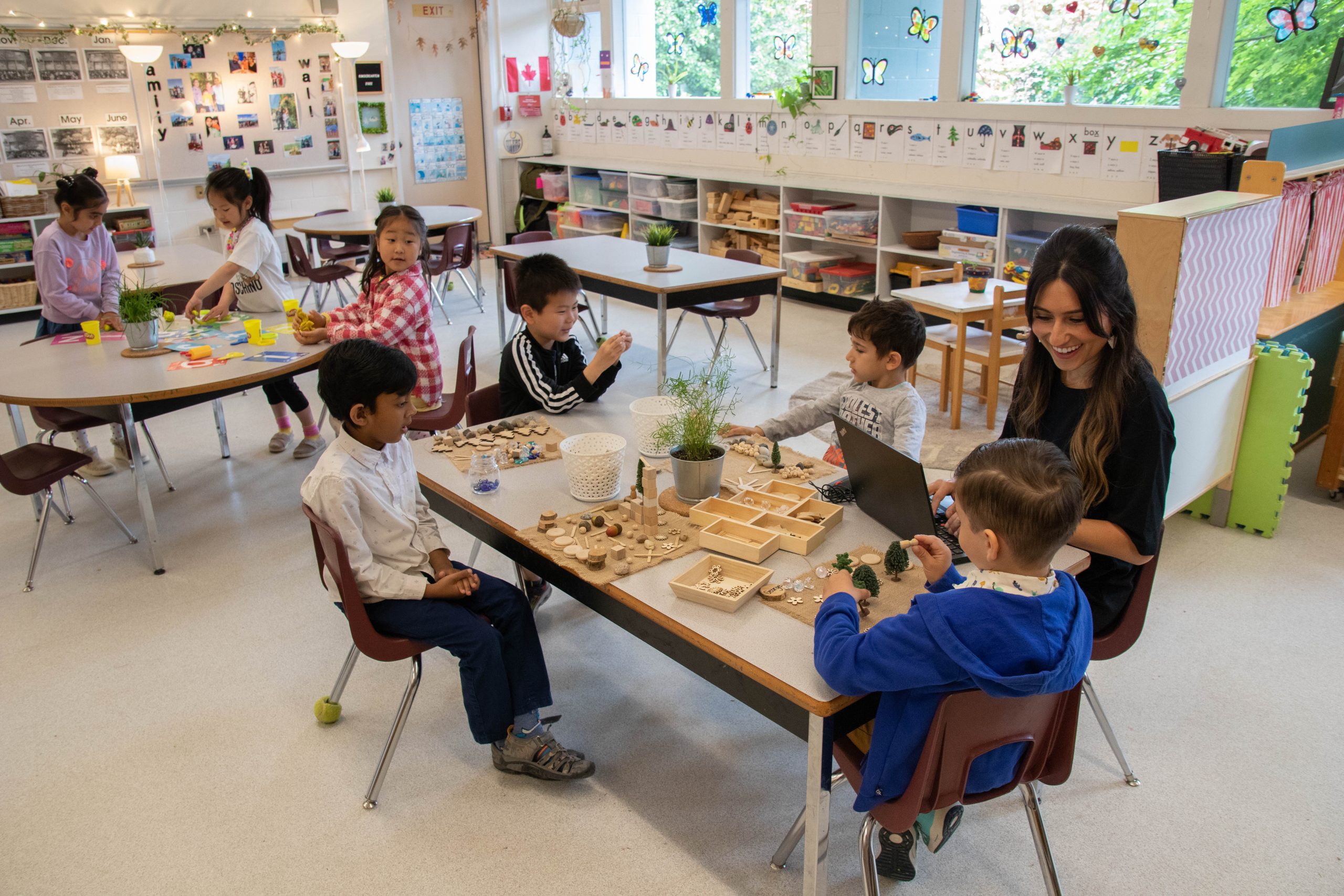
Mackenzie’s passion for her students and her craft are not limited to the outdoors. Walking into her classroom is like walking into the children’s section at an IKEA showroom. One would not know that kindergarteners learn and play here – everything is neat, tidy and stored in its proper place. The décor is warm, inviting, and absolutely charming, giving an immediate sense of calm as you enter her classroom. A twinkling fairy light tree sits in a cozy reading nook stuffed with pillows, real plants line each student table, and colourful rugs and pom-pom garlands pull together the space.

Mackenzie explains that she uses the Reggio Emilia philosophy that features calming and all natural materials, in a child-focused and community-oriented approach to teaching. She maintains that showing kids by example is the best way for them to learn and internalize concepts, including how to be a responsible custodian of a shared space.

“I got to expand my own knowledge and understand developmentally where [my students] are at, and how I can meet them there, and give them the tools and guidance to help them in life.”

Mackenzie’s MEd program in Early Childhood Education has played a huge role in helping her find her niche. When she first started teaching 8 years ago, she explored teaching various age groups, but has since been able to hone in on her own interests in early learning and how to best apply her learning to benefit the students. “I was able to find where I fit best, and where I excel as a teacher,” she reflects.

Completing her program gave her the knowledge and experience to incorporate back into the classroom, and the research to back up her methods. Her capstone project was on the ​cognitive, social-emotional, and physical development of children in the early years. “I got to expand my own knowledge and understand developmentally where [my students] are at, and how I can meet them there, and give them the tools and guidance to help them in life.”

The program was extremely valuable for Mackenzie, and she notes the importance of continuing to learn and grow as a person and educator. She appreciated the opportunity to be in an environment where she could think critically about the topics she was interested in, while surrounded by like-minded colleagues.

“I’m continuing to learn and stretch and grow, and this was a beautiful step to be able to do that,” she acknowledges.

As the kids start to arrive that morning, she greets them each warmly with a passionate “I’m so glad you’re here!” She has them start each day with the same routine, beginning with putting their unique personalized and labeled rock into the “attendance” basket. They then move on to answer the daily question on the whiteboard – today’s question: “which colour do you like best, red or purple?” The overwhelming consensus so far is red.

The next activity is Story Workshop – natural materials like wooden stars, rocks, glass pebbles, and tiny felt trees are laid out on tables for students to build out a story picture on a burlap canvas. Mackenzie notes that this activity supports language and literacy development in a play-based way, and that she makes sure the students know that they can come to this activity on their own time, when they are ready. Once they are done building their pictures, they tell their stories to Ms. Radomski. Soon we start to hear snippets of elaborate tales about forests, magical eggs, and heroes named Cucumber. Mackenzie prompts for more with “and where does the story take place?” or “and how did that make them feel?” – encouraging the students to dive deeper into their imaginations.

As the morning progresses, Mackenzie smoothly transitions the students from their story creations over to the reading nook where she takes out “Picture a Tree” by Barbara Reid. “We’ve read this one before,” one student objects! “Yes, I know, but it’s such a good one!” Mackenzie replies with a mischievous grin. They are enthralled none-the-less. In between activities Mackenzie makes time to connect with each child. As she starts to fix the hair of one little girl, Mackenzie confides that “sometimes this job requires you to be a jack of all trades,” though she doesn’t seem to mind.

“We wanted to re-connect our students to the community and the land.”

Mackenzie’s learnings from her MEd program and her expertise in early learning is evident throughout all her interactions with the students. “This focus changed the way that I teach. I now prioritize how children feel and how they interact with others, and make that the biggest component of our day.” Incorporating play-based learning and nature in most of her activities, her approach applies a growth mindset and inquiry focus that encourages students to ask questions and explore themselves, their feelings, and the world around them. “It’s endless and daily, where we are learning about ourselves, others, and the world we live in.”

Our visit ends outside, as Ms. Radomski leads the kids to the playground behind the school. They fan out quickly, taking over the monkey bars, jungle gym, slides and climbers. The favourite by far, however, is the monorail – the kids hang tight to the handle while Ms. Radomski gives them a gentle push and they go sliding down the rail, squealing with delight as they fly through the air.

After some energy has been spent in playground merry making, Mackenzie leads the kids to the back of the playground where we finally get to see her Gathering Tree. It is lovingly adorned with colourful trinkets and art pieces made by Mackenzie’s kindergarten class with the help of their big buddies (older children paired with kindergarten students). Rainbows, flowers, and feathers dangle from the still-thin branches like a charming Charlie Brown tree. And if that wasn’t sweet enough, small strawberry plants encircle the bottom of the tree, promising a ripe harvest in the next few weeks.

Mackenzie brings out the sit pads, and has the kids sit by the tree and draw out scenes from the nature surrounding them. As they sit calmly, focusing on their task, Mackenzie goes around to each of them, checking in on their progress and pointing out other details on the tree they may have missed. “We wanted to re-connect our students to the community and the land,” Mackenzie says, and watching this scene play out I would say she accomplished just that.

Mackenzie approaches her teaching the same way she has approached decorating her classroom – with a warm, comforting and caring attitude that clearly has made her well loved by her students. Whether she is helping the kids build worlds on a burlap canvas, or connecting them to their natural surroundings in the outdoors, Mackenzie has found her calling and is playing a huge role in helping these children reach their full potential.

While acknowledging that there are hard days and challenges to her teaching role, she ultimately gets so much fulfillment from working with her students and has a wealth of gratitude for the position she is in. She loves watching them play, explore and inquire, and being able to contribute to their unique growth journeys.

“There is so much goodness and positivity that comes from kids – not only do I teach them, but they teach me, every day.”

Article written by Milena Constanda | September 2022
Photos by Milena Constanda
View full article.

Alumni Profile: Mihai Cirstea, B.Sc. ‘11

Freelance article for St. Paul’s Hospital


October 2014

Screen Shot 2015-08-23 at 8.33.26 PM.png

The stakes are high in the field of Health Sciences research, but the reward of helping people makes it worth it for UBC Cell Biology and Genetics grad Mihai Cirstea. “I’ve always liked the Health Sciences and I felt this degree could lead to a career where I could help save lives, either through medicine or through research.” 

Since completing his Bachelor of Science degree in 2011, Cirstea has been employed at the UBC Centre for Heart Lung Innovation at St. Paul’s Hospital where he plays a critical role as a lead research scientist, doing clinical research on improving outcomes for patients with sepsis – a potentially life-threatening complication of an infection.  

For Cirstea, his experience as a student at UBC solidified his desire to pursue this type of research in his career. “UBC is a world-class institution in terms of their medical program and the research facilities, and I got a lot of exposure to that. The experience I gained working in those facilities, and the connections I made during my degree, excited a passion in me to pursue a career doing health research at UBC.” 

Cirstea and his team at the UBC Centre for Heart Lung Innovation are working to fight sepsis, which has a mortality rate of roughly thirty percent. Their lab has recently developed a potential new treatment to boost the body’s natural ability to clear infectious toxins from the blood during sepsis, which could be a major step to improve the survival rate of patients affected by this condition. “Soon we’ll be starting a clinical trial to test this treatment’s ability to significantly reduce complications and mortality associated with sepsis.” 

Doing clinical research is important to Cirstea for many reasons, not least of which is the ability to help those who are most in need in his community. “Many of the patients we see come into St. Paul’s Hospital are from the Downtown Eastside, which allows me the opportunity to help improve the lives of one of Canada’s most vulnerable populations in a meaningful way,” Cirstea reflects. 

The future of medicine and health research is changing, and Cirstea is excited at the prospect of what his work can achieve, and how it will contribute to science innovation in the future. He notes that the aging population, increases in chronic diseases, and overwhelming economic strains on the healthcare system have led to an increased focus on personalized medicine and outcomes-based research. 

Cirstea recognizes that UBC is playing an instrumental role in this rapidly changing field, and he credits his University for enabling him to do the important work he is doing. “UBC’s partnership with St. Paul’s Hospital allows our research program to work directly with sepsis patients in the hospital setting, which enables cutting-edge bench-to-bedside research that will have direct and immediate benefits for our patients and for the entire research field.” 

Article by Milena Constanda
Photo: Greg Morton for Promise Magazine

MET welcomes Dr. Kisha McPherson as a permanent lecturer

Article for the Master of Educational Technology (MET) program | December 2020


December 13, 2020

The MET program has welcomed Dr. Kisha McPherson as a full-time lecturer to the team – she started in summer 2020.

Dr. McPherson has well over a decade of experience teaching students of all ages, ranging from kindergarten to post-secondary. Her work centres on themes of social justice, equity in education, media, and cultural studies; her research interests focus on cultural and Black studies.

“My research is focused on examining the uses of technologies for resistance to structures of oppression,” she explains.

“For example, my most current research project centres the knowledge production of Black girls as a form of resistance pedagogy.”

Dr. McPherson was slated to teach ‘ETEC 565T: Critical Media Literacy’ this summer, but unfortunately the realities of the current pandemic meant the Summer Institute was cancelled. However, she offers a glimpse into what the course would have entailed: critically examining media representations, and the effects this has on our understanding of others.

“This MET course was designed to focus on representations that create isolation and maintain oppressive narratives,” she notes.

Students would then be asked to apply their skills to create and apply alternative tools in order to improve media literacy.

When asked what she enjoys most about teaching in the MET program so far, her reply shows a genuine passion for the subject matter, and those she teaches and hopes to inspire. One aspect she appreciates is that “[MET] courses take an interesting approach to exploring and examining the intersection between education and technology,” and that they “assist students in developing key skills that can be applied in their professional practices.”

“I enjoy learning from students about the types of situations they encounter and together working with students to strategize on solutions through the course material and our lived experiences.”

What Dr. McPherson is most passionate about, however, is using her teaching to demonstrate her commitment to equity.

“My goal is to create safer spaces for students to develop their own practices that are based on equitable approaches to teaching and learning.”

Dr. McPherson is currently teaching: ETEC 500ETEC 530ETEC 531, and ETEC 542.


View full article.

Choosing the Right Online Teaching Platform

Interview edit for the Educational Technology Support unit | July 2020


Interview with Dr. Bonnie Nish

July 29, 2020

Collaborate Ultra Vs. Zoom

For my LLED 361 course (Literacy Practices and Assessment: Secondary), I initially started in Zoom, but then moved to using Collaborate Ultra. It was just little things that I was noticing that didn’t work for me. For example, I created a Zoom meeting and I sent the students the link by email, and I also put it into the announcements for everyone to have. Then the day of the class, I noticed there were two people in the waiting room whose names I didn’t recognize. I thought maybe they had different emails so I thought I’d just wait and see.

I recognized everybody else and I let everyone in except for these two people. I realized that they probably weren’t meant to be here and I just wondered how they could have gotten the link. It made me nervous because I had recently been in an AGM meeting where we were Zoom-bombed, and it wasn’t a nice feeling; it was very disturbing. The last thing I wanted was for that to happen in my course. I wasn’t feeling too comfortable with Zoom, even with all of the security around Zoom that UBC has taken. The fact that there were two people in my waiting room that weren’t supposed to be there concerned me, and I had no idea how they got there.

Another issue I had with Zoom was I once had a guest speaker, and the students were asking questions in the chat. I read out a question from the chat and the guest speaker was answering, suddenly I looked up and the student who had asked the question was in the waiting room, because her Zoom call had dropped. I quickly let her back in and I had to ask the guest speaker to please repeat their answer because I had just noticed that the student who asked was out of the room while they were talking. She was just booted out. Little things like this were happening for me in Zoom.

Because of these things, I ultimately decided at that time to go back to Collaborate Ultra. I felt like there was a little more flexibility with Collaborate Ultra, so I stayed in that platform for the rest of the course. However, since then I have become much more familiar with Zoom and I will actually be switching to this platform for my next course. I have found that Collaborate Ultra lacks certain things which Zoom offers. The speaker view for instance is more limiting in that you can only see a few people at a time. While Zoom tends to drop people, the actual connection is better in Zoom in that it is clearer. They both have advantages and disadvantages, and familiarizing yourself with each is important in order to find your comfort level and what works for you.

“[Zoom and Collaborate Ultra] both have advantages and disadvantages, and familiarizing yourself with each is important in order to find your comfort level and what works for you.”

One of our classes was about using memes, in classrooms, in teaching – so I made a meme for them. It’s a superhero, and the first box shows a finger trying to decide between two red buttons, one labelled “Zoom” and one labelled “Collaborate Ultra”. And then the next box shows a superhero just sweating it out. And at the beginning of class I told them this is what working with technology has been like for me.

To Powerpoint or not to Powerpoint?

In the beginning I was using PowerPoint in my lectures. I thought, just for my own sake, I can use this to teach so they’re not just looking at me the whole time. But I quickly did away with that because I realized in Collaborate Ultra I couldn’t see anybody while sharing a PowerPoint presentation. Anytime I shared my screen, I would have somebody else let me know if anybody had any concerns in the chat, and I just felt like it didn’t work as well to have the PowerPoint there. In Zoom, however, I can still see the students in gallery view and I don’t feel I am talking into space. So sharing a PowerPoint feels more comfortable in Zoom.

While I was using Collaborate Ultra, I ended up just putting the PowerPoint presentations up online for students to access on their own time. Especially if somebody hadn’t had a chance to read the reading that week, they had that to help, and for extra reference. So that was one thing I found I had to adjust for. And I just found keeping the actual teaching time short, and giving them a question from the reading to go into breakout rooms and discuss worked better. Making sure they have a lot of asynchronous time for assignments is key.

“In Zoom … I can still see the students in gallery view and I don’t feel I am talking into space. So sharing a PowerPoint feels more comfortable in Zoom [compared to Collaborate Ultra].”


I was constantly adapting, because I hadn’t taught online before. I had to switch to shorter lectures – about fifteen minutes tops. While we had been told that this was better, you really don’t understand this until you’re in it and get to experience it first hand.

Advice for Instructors New to Online Teaching

Get a group of people together, whether it’s family or friends, and go into both platforms beforehand, just to get a feel for it. It’s one thing to go in by yourself and navigate it, but it’s far more useful if you’re in there with a group where you’re actually putting people into breakout rooms or assigning breakout rooms in each platform, just to see which is more comfortable.

I know a lot of people prefer Zoom, and it might be great, but I think having a handle on both platforms is beneficial. They both have great things that they offer, but actually walking through all of these different things, using the whiteboard, sharing your screen, uploading things beforehand, putting people into breakout rooms in groups and moving them around; doing all that, and having people there in the moment to give you feedback, will really help. If you can do all that comfortably, I think that’s going to give you a big head start into using these platforms. And I would do both of them just because some people might want to go back and forth. Some people might find one is easier than the other.

Biggest Takeaways for Preparing your Course

Be aware that it’s an ongoing process. I mean, teaching is anyway, so you plan lessons as best as you can. And sometimes things go wrong – I probably had everything possible that could go wrong with technology go wrong for me! Just be aware of this, and give yourself a break, if you’re just learning it. Accept that it’s a learning process, and you’ll find your flow eventually. I felt like by the third week I was starting to really get a handle on it. It just takes some time to get used to it, and to be comfortable within each platform. It is different than teaching in person – it’s very different.

One of the things I like to do in my classroom is create a sense of community, where students feel they can talk and be together. How do you do that online and really get a sense of who everybody is and those conversations? Breakout rooms, discussion boards and short class discussions are really great ways to do that. It’s constantly a learning process.


View full article.

The Problem of Stray Dogs in Romania

The Nature Association Animal Shelter, Romania | January 2011


The problem of stray dogs in Romania is not an ancient one – in fact, it is only about one generation old. Before and even during the days of Communism, Romanians and dogs shared a strong relationship, with many people in the country regarding them as loyal work partners or guard dogs for their farms, and many in the city regarding them as beloved pets. However, in the late 1980s, former dictator Nicolae Ceausescu began demolishing residential houses in large areas of Bucharest in order to build communal apartment blocks, where no pets were allowed. Faced with no other choice, thousands were forced to abandon their pets, and so the massive street dog problem began.

1989 saw the fall of Communism, but throughout the 90s the problem of stray dogs only became worse. Multiplying rapidly and always searching for new sources of food and shelter, these homeless dogs soon grew to occupy all areas of Bucharest and indeed most of the country. Unsterilized, undomesticated, and living in constant fear and danger, these dogs stopped resembling the loving pets that Romanians were so fond of, and instead began to be seen as a nuisance and even a menace.  People now saw them as vermin that made the city dirty and undesirable to tourism. The spread of disease also became a concern. Incidents of dog bites numbered over 1000 per month, and the associated medical costs were a burden to the health care system. Many people just wanted them gone, at any cost.

In 2001, Mr Traian Basescu was elected mayor of Bucharest, and he pledged to end the stay dog problem once and for all. His method was far from humane – he introduced a law promoting the capture and mass euthanasia of all the city’s dogs. Despite massive international and even domestic outcry, this law passed, and between 2001 to 2004, over 100,000 stray dogs were rounded up off the streets of Bucharest and killed, usually by being shot, or by being crammed together in a closed room with hundreds of other dogs till the spread of disease or hunger killed them off.

In 2004, Mr Basescu was elected President of Romania, and now with larger political motives in mind, the killing campaign was called off. The reduction in the number of stray dogs will never be known for sure, but up to 75% may have been brutally killed. However, the numbers did not stay down for long. Since Mr Basescu’s campaign put no emphasis whatsoever on sterilization, the remaining dogs now had a large surplus of area and food and, since a female dog can have up to 16 puppies a year, the population rebounded to near-peak levels in only 2 or 3 years. They remain at these levels today. Nothing was solved, and thousands died horrible deaths for essentially purely political reasons.

Something that isn’t inherently obvious to people who know of our shelter is that, just like Mr Basescu and millions of others in the country, we too want all the dogs off the streets. Their suffering is great, their threat to the public is real, and most of all, man’s best friend deserves better. Although the state-sponsored killing has stopped, every year thousands are still hit by cars, poisoned, or die from hunger, cold or disease. How we differ vastly from Mr Basescu, of course, is in our methods and our humanity. Rather than killing campaigns, which are both horribly cruel and – as was seen – ultimately ineffective, our solution is based on mass sterilization campaigns, coupled with properly funded, well-managed humane shelters and adoption centres. This problem needs a humane solution, and it is well within our grasp.  To read more about why we think sterilization will succeed where euthanasia failed, read “Our Solution”!


Read full article.

Take the Master of Educational Technology graduate program online

Paid Article for the Georgia Straight | April 2020


The Master of Educational Technology (MET) is offered by the University of British Columbia (UBC) and is 100 percent online-based.

The MET is an international online graduate program that educates professionals in the use and impact of digital learning technologies. This program provides a unique opportunity for its students to study and engage in:

  • Technology-supported instruction
  • Planning and management of learning technologies and eLearning
  • Design and development of digital learning technologies and environments
  • Digital literacy and digital culture in formal and informal learning contexts

UBC’s faculty and instructors work on the leading edge of curriculum design and technology integration, digital culture, youth culture, digital literacy, gaming, and interface design.

Are you interested in educational technology, want to specialize your skills, and advance your career in this field? If so, learn more about what this unique program has to offer.

Please apply online here by May 15, 2020. The MET program starts September 2020.


View full article.

The New School Year Ahead

PDCE Newsletter | September 2020


With schools set to open in BC on September 10, teachers are no doubt left with many questions about how exactly things will work for them and their students.Teachers have done so much work to adapt to a new reality these past few months, and are doing a lot more now in preparation of the new school year and a return to in-person classes.

The return-to-school plans will look different for each district, with some districts also considering larger scale changes and system transformations, and every teacher will need to be flexible as they navigate and adapt to this new school year ahead.We know that despite the uncertainties the future may present, BC teachers will rise to the occasion and offer exceptional education and support to students during this unprecedented time.

We believe in you, and we’re here for you!

The PDCE Team


View full newsletter.

Bringing Mental Health to Schools

PDCE Blog Article | October 2018


A Canadian-developed, research-based, classroom-ready resource bringing mental health to your school. Designed especially for educators teaching Grades 7-12.

Mental health is a term steadily gaining mainstream popularity, but what does it really mean? The Canadian Mental Health Association states that “mental health is more than mental illness. It’s more than being happy all the time. It’s about feeling good about who you are, having balance in your life, and managing life’s highs and lows”.

Mental Health Week took place this year between May 7-13, but a topic as important as this deserves recognition year-round; we at PDCE encourage you to regularly prioritize and nurture your own mental health and that of others.

As a teacher, that responsibility extends to your students. Do you have the skills, knowledge and tools to address mental health in your classroom? If you feel you could sharpen your expertise in this area, then our ‘Bringing Mental Health to Schools’ online MOOC is for you!

Do you have the skills, knowledge and tools to address mental health in your classroom?

This Canadian-developed, 100% online, modular curriculum resource provides classroom-ready lesson plans that support provincial and territorial curriculum frameworks. This course is strictly evidence-based, and was developed by Dr. Stan Kutcher, and Dr. Yifeng Wei of Dalhousie University.

  • Dr. Kutcher is the Sun Life Financial Chair in Adolescent Mental Health and the Director World Health Organization Collaborating Centre in Mental Health Policy and Training at Dalhousie University, and IWK Health Centre in Canada. He is a leader in mental health research, advocacy, training and policy and has been involved in mental health work in over 20 countries.
  • Dr. Wei has worked as a researcher and school mental health lead with the Sun Life Financial Chair in Adolescent Mental Health team since 2008. Her research interest has focused on promoting mental health literacy in schools to help students achieve better understanding about mental health and mental disorders, reduce stigma against mental illness, obtain and maintain good mental health and enhance help-seeking behaviours.


But don’t take our word for it; those who have completed our MOOC have great things to say. Samantha Tomlinson – a teacher in Ontario – completed the course in January 2018, and says the course “was the most beneficial teaching-related course I have taken. It was well laid out, and completely ready for the classroom.” Similarly, Jeremy Church – one of the reviewers for this MOOC, and a champion in North Vancouver for implementing the Guide – notes that “the content of the course is engaging, relevant, and addressing a real need in our schools today.”

Church highlights the following key takeaways teachers can expect to gain from the course:

  • An understanding of the teen brain and it’s development
  • Language and knowledge to distinguish between mental distress, mental problems, and mental illness
  • The importance of normalizing teenage emotions, without pathologizing them
  • How to teach youth about mental illnesses, including signs and symptoms
  • How to support youth with help-seeking behaviours, including accessing of resources and self-advocacy

“This was the most beneficial teaching-related course I have taken. It was well laid out, and completely ready for the classroom.”

The Bringing Mental Health to Schools MOOC is especially designed for junior high and secondary classrooms, and is proven to improve outcomes for both teachers and students. It focuses on myth busting and decreasing the stigma around mental health, and is available to all Canadian educators. The course format is self-paced, with 6 modules (45 minutes each) each comprising of classroom activities, self-guided study, and a module test – all for just $20 CDN!

Find more information at our Bringing Mental Health to Schools webpage: pdce.educ.ubc.ca/mentalhealth

Register today for this timely and important course, and help to bring mental health to schools!

Register Now!


View full blog article.